Catalog No.: PC-27477Not For Human Use, Lab Use Only.
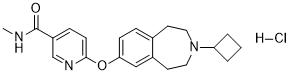
GSK189254 (GSK189254A hydrochloride) is a potent, selective histamine H3 receptor (H3R) antagonist with pKi of 9.59 -9.90 and 8.51-9.17 for human and rat H3R respectively.
GSK189254 (GSK189254A hydrochloride) is a potent, selective histamine H3 receptor (H3R) antagonist with pKi of 9.59 -9.90 and 8.51-9.17 for human and rat H3R respectively. GSK189254 exhibits potent functional antagonism (pA(2) = 9.06 versus agonist-induced changes in cAMP) and inverse agonism [pIC(50) = 8.20 versus basal guanosine 5'-O-(3-[(35)S]thio)triphosphate binding] at the human recombinant H(3) receptor. GSK189254 inhibits cortical ex vivo R-(-)-alpha-methyl[imidazole-2,5(n)-(3)H]histamine dihydrochloride ([(3)H]R-alpha-methylhistamine) binding (ED(50) = 0.17 mg/kg) and increases c-Fos immunoreactivity in prefrontal and somatosensory cortex (3 mg/kg). GSK189254 (0.3-3 mg/kg p.o.) increases the release of acetylcholine, noradrenaline, and dopamine in the anterior cingulate cortex and acetylcholine in the dorsal hippocampus. GSK189254 significantly improves performance of rats in diverse cognition paradigms, including passive avoidance (1 and 3 mg/kg p.o.), water maze (1 and 3 mg/kg p.o.), object recognition (0.3 and 1 mg/kg p.o.), and attentional set shift (1 mg/kg p.o.).